
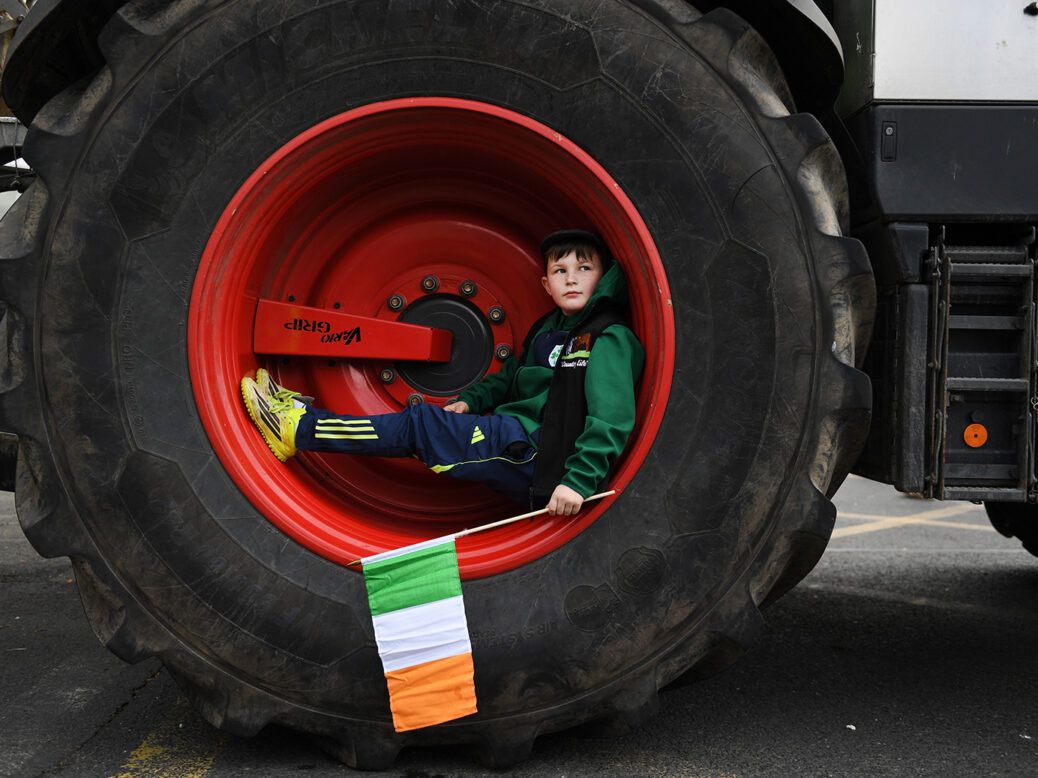
Three weeks ago, James Geoghegan was an unknown agricultural contractor from Westmeath, Ireland. Today, he is a leading figure in a protest movement that has brought the country to a standstill: tractors have lined the streets of Dublin and Cork, farmers and hauliers have blocked passage to the airport, and demonstrations have choked access to fuel depots in Limerick and Galway.
It began in a TikTok live chat. “We’re all agricultural machinery men [in the TikTok group],” Geoghegan told the New Statesman. “We’d go on for half an hour one or two nights a week, just for a chat among ourselves. Something to do really.” He said they’d discuss farming, weather and the “issues of the day”.
The spike in global fuel prices because of the war in Iran was enough to push the already weary agricultural community over the edge. When one of the men on the TikTok group had a contract cancelled – the customer couldn’t afford the spiralling costs of the project – alarms rang. “We’re all self-employed business people, so we’re all thinking ahead and looking at the future, and we can just see a disaster coming,” he said. A plan was decided upon to block roads and fuel depots around the country.
“We decided we’re going to Dublin, because Dublin is our capital and we’re not too far from it. And then down south, the lads down in Cork decided they’d do a couple in Cork and that’s how it just started. Then it just took off.” Geoghegan said there are currently 40 separate actions taking place across Ireland. In Dublin, they have caused significant traffic disruption for a week. The Gardaí (Ireland’s police force) have had to divert vehicles from key routes and warn motorists of delays, while the area around Leinster House (Ireland’s parliament) has been cordoned off for three days.

The protests have drawn in a loose coalition of farmers, hauliers, small contractors and other self-employed workers, squeezed by rising fuel costs. The price of diesel has risen from €1.70 (£1.47) per litre to €2.17 (£1.89), and petrol has increased from €1.74 (£1.51) to €1.97 (£1.71) in recent weeks. Geoghegan said the aim of the movement is to “educate” the government, which he says is run by politicians with no real experience of business. “They keep refusing to listen.” In an attempt to mollify the protesters, the government announced a 10-cent reduction per litre on both diesel and petrol, and a 2.4-cent reduction per litre on marked gas and oil. It has also postponed a planned increase in carbon tax from May until the budget in October. The support package costs €505m (£439m).
Geoghegan is unimpressed: “The package they brought out [on Sunday] is not going to help, so as things stand we’re still heading for a depression.” It also appears to have done little to mitigate the political impact. After Geoghegan and I spoke, Michael Healy-Rae, an independent TD from Kerry, resigned as a junior minister in order to vote with the opposition in a no-confidence motion against the government.
A poll released on Sunday showed 56 per cent of Irish people support the protesters. Geoghegan said there was “a lot of support” for them. “We were in Dublin City, and the city people was all behind it,” he said. “I got a taxi home back to the house where I was staying, and the taxi driver, who is originally from India, has come to Ireland to make a living, and has his own taxi. He brought me home, and he wouldn’t take any money off me. He said, ‘No James, you’re helping us, you might save us.’”
The fuel protests haven’t come from nowhere. Plus, Ireland has been no stranger to public disorder in the past few years, with the 2023 Dublin riots the most violent in the city’s modern history. So what else is behind the most recent outburst? Geoghegan rattles off a few explanations: the spiralling cost of the National Children’s Hospital in Dublin, which is expected to exceed €2bn; the homelessness and housing crises, with more than 17,000 people in emergency accommodation; and the spike in immigration.
Since 2023, angry anti-immigration protests have sporadically erupted on the streets of the capital, outside asylum centres, and over the border in Belfast. There were a record number of asylum applications in 2024, as well as conspicuous migrant encampments along the banks of the canal in central Dublin. Tensions have been exacerbated by the intake of 100,000 Ukrainian refugees since 2022. While the recent fuel protests are not explicitly anti-immigration, some Irish far-right figures have joined them.
Geoghegan’s time in Dublin has been startling. “I was on O’Connell Street in Dublin last Thursday night, feeding the homeless people with food that people have brought to us. Local people just brought all sorts of sandwiches, with restaurants bringing out burgers and chips. I just said to myself, isn’t it so sad that I come up here as a farmer from the midlands of Ireland and end up feeding the homeless in our capital city when our government doesn’t care?”
Despite this, there is plenty of frustration at the disruption caused – some workers in Dublin describe being stuck in traffic for hours when convoys of tractors moved through the capital, while small-business owners say footfall is dropping. On social media, the discontent is simply expressed: why punish ordinary workers rather than politicians? Geoghegan instead told RTÉ (Ireland’s state broadcaster) that this was “a revolution” that would “change Ireland forever”.
A spate of articles has emerged in recent days on aspects of Geoghegan’s past, including reports of previous convictions related to animal welfare breaches and an outstanding tax liability dispute with the Revenue Commissioners. On the animal welfare charges, he told me it was “totally blown out of context”. “There was no actual animal cruelty, there was natural losses on the farm.” He added that he had “cleared up” the money owed with the Revenue. “That money was never actually owed,” he said. However, the Irish Times reported that the collector-general had secured six debt judgements against him over a period of six and a half years for a total of almost €550,000.
Organisers say further demonstrations are planned in the coming days, with the possibility of larger, more coordinated actions if demands are not met. He mentions Spain – where the government has introduced measures to cut fuel prices by up to 30 cents per litre. There has been speculation that the protests could spread to Britain. The Times reported that Tommy Robinson was trying to invoke them when advertising his “Unite the Kingdom” march this summer. Geoghegan said there had been some interest in their TikTok live discussions, with a farmer from Wales joining to discuss fuel prices in the UK. But, he added, “what you do over there is your own business”.
[Further reading: Trump and Mamdani see two different Irelands]
Content from our partners

Related
Join the debate
Subscribe here to comment